Article: Breguet Dials Explained: Hands, Numerals and Guilloché
Breguet Dials Explained: Hands, Numerals and Guilloché
A Breguet dial rewards a second look. A photograph may first register as a pale surface, blue hands and a few calendar indications. Look closer and the dial becomes a carefully organised arrangement of textures, borders and shapes. Understanding that visual language makes browsing pre-owned Breguet watches more interesting: you can compare how a watch presents information, as well as its size and movement.
The Classique family is a useful starting point, although its design details are not a checklist shared by every Breguet. Here is how to recognise the main elements and decide which combinations appeal to you.
What are Breguet hands?
The familiar Breguet hand has a slender shaft and a hollow, rounded feature near its tip. Often described as an open apple or crescent, that outline gives the hand a distinctive silhouette without filling the dial with heavy decoration. Breguet dates Abraham-Louis Breguet’s development of the style to around 1783, using gold or blued steel.
The name describes a hand design, not proof of who made the watch. Breguet’s own historical account explains that other watchmakers adopted the style. On a pre-owned example, treat the hands as one part of the overall assessment rather than a shortcut to authenticity.
Guilloché: decoration that helps organise the dial
Guilloché, also called engine-turning, creates repeated engraved patterns in a surface. Breguet’s historical timeline records its use on Abraham-Louis Breguet’s watch dials from 1786. Traditional engine-turning uses a lathe operated by an artisan; the machine guides the repeated geometry while the craftsperson controls the work.
The point is not simply to make a dial busier. Different patterns can separate an hour display from a seconds counter or another indication. Breguet also describes the technique’s role in reducing reflections and improving readability. A border between two textures can be easier to notice than an extra printed line.
When comparing watches, look at where the patterns change and what those changes achieve. Does your eye find the time immediately? Is the calendar distinct from the main display? Those questions turn a decorative detail into something you can assess for yourself.
Breguet numerals and Roman numerals are different choices
“Breguet numerals” refers to the distinctive Arabic numeral style associated with the house, rather than every set of numbers on a Breguet watch. The brand dates these numerals to 1783 and includes them among the Classique collection’s recognised design elements.
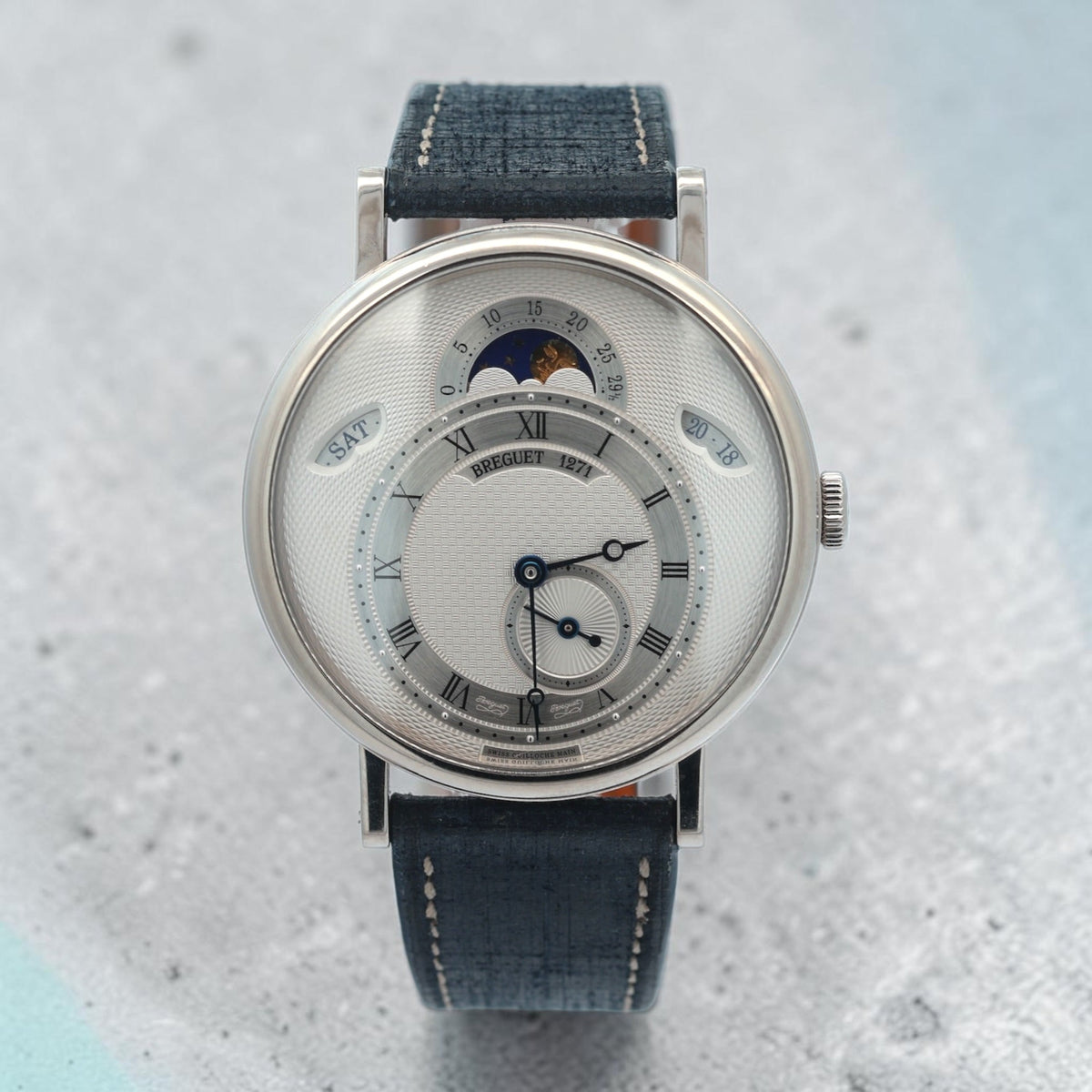
However, Roman numerals also appear on Classique watches, including the 7337 example pictured here. There is no contradiction: the hand shape, dial finish and hour markers are separate design choices. Likewise, the Classique range includes enamel as well as guilloché dials. Decide whether you prefer a quieter surface or the changing texture of engraved decoration, rather than expecting one universal specification.
A practical example: the Classique Calendrier 7337
Our Breguet Classique Calendrier 7337 listing provides a useful illustration. In the photograph, the time display sits below the centre of the case, with a small seconds display inside it. Above are the moon-phase display and two calendar apertures. The Roman hour ring and different surrounding textures give these overlapping elements their own space.
Try reading it in stages: find the hour and minute hands first, then the seconds, then the calendar and moon phase. Notice how the dial guides that sequence without making every indication equally prominent. This is our reading of the photographed design, rather than a claim that everyone will find the same layout most legible.
Check the individual listing for its complete reference, condition, accompanying items and current availability. A family number such as 7337 is not enough to transfer every specification from another example or a current manufacturer page.
How to judge a detailed dial before buying pre-owned
Begin with a straight-on photograph, then ask for another angle or a short video in ordinary light. Strong lighting can emphasise a pattern while hiding a mark; a flat image can do the reverse. Compare the whole dial before zooming into one detail, so that magnification does not distort your impression of the watch on the wrist.
Ask about any known dial or hand replacement, refinishing or other work, and distinguish documented information from an assumption. A recognisable design feature does not establish originality. If the watch’s age matters to your decision, ask how it has been determined rather than calling every traditionally styled watch vintage.
For calendar watches, request the correct operating instructions for the exact reference. Appearance alone cannot tell you how its calendar should be adjusted. Our pre-owned watch buying guide covers the wider questions about condition, fit and accompanying documents.
Choosing the Breguet you enjoy looking at
Spend a little time with the dial before deciding. A restrained display may suit you better than a calendar, or the balance of a more involved layout may be the attraction. Browse our pre-owned Breguet collection to compare individual examples, or enquire about a watch and a Birmingham viewing. The useful choice is the one whose details you appreciate in person, not the one with the longest list of features.
Further reading: Breguet’s accounts of its hand design, guilloché from 1786, traditional engine-turning and Classique design signatures.