Article: Breguet Type XX Flyback: How the Chronograph Works
Breguet Type XX Flyback: How the Chronograph Works
The Breguet Type XX is defined as much by what its chronograph can do as by its aviation-inspired appearance. Its signature flyback function—historically called retour en vol—lets the wearer reset and restart a running chronograph with one press. That practical shortcut links today’s pre-owned examples to the timing requirements of early military aviation.
Here is how the function works, where the Type XX name came from and what to compare when considering a pre-owned example.
How aviation shaped the Breguet Type XX
Breguet’s connection with aviation predates the Type XX. The house supplied instruments for aircraft and developed specialist chronographs as flying became increasingly important during the twentieth century. In the early 1950s, the French Ministry of Defence sought robust wrist chronographs for military aircrews under the designation “Type 20”.
Breguet’s official archives record prototypes and early watches with a special reset-and-restart function before the Type 20 name appeared in its registers in 1953. Military deliveries followed during the 1950s, including watches for the French Air Force, the Flight Test Centre and French Naval Aviation.
The names require some care. Breguet explains that its military pieces were recorded as Type 20, using Arabic numerals, while civilian watches were generally called Type XX in Roman numerals. Historic examples vary, so a name alone is not enough to establish the specification or history of an individual watch.
What does a flyback chronograph do?
A conventional chronograph usually requires three operations to time a new interval: stop the running chronograph, reset it to zero and start it again. A flyback chronograph combines those steps. Pressing the reset pusher while the chronograph is running sends its timing hand back to zero and immediately begins a new measurement.
For an aircrew measuring consecutive stages of a journey or manoeuvre, removing two button presses saved time and reduced distraction. The same function remains useful away from aviation. It can time repeated laps, short stages of a journey, cooking intervals or any sequence where one measurement follows another without a pause.
The flyback action should not be confused with the normal reset of a stopped chronograph. If you are unfamiliar with the watch, ask for the correct operating sequence to be demonstrated rather than repeatedly testing its pushers without guidance.
Reading the dial and bezel
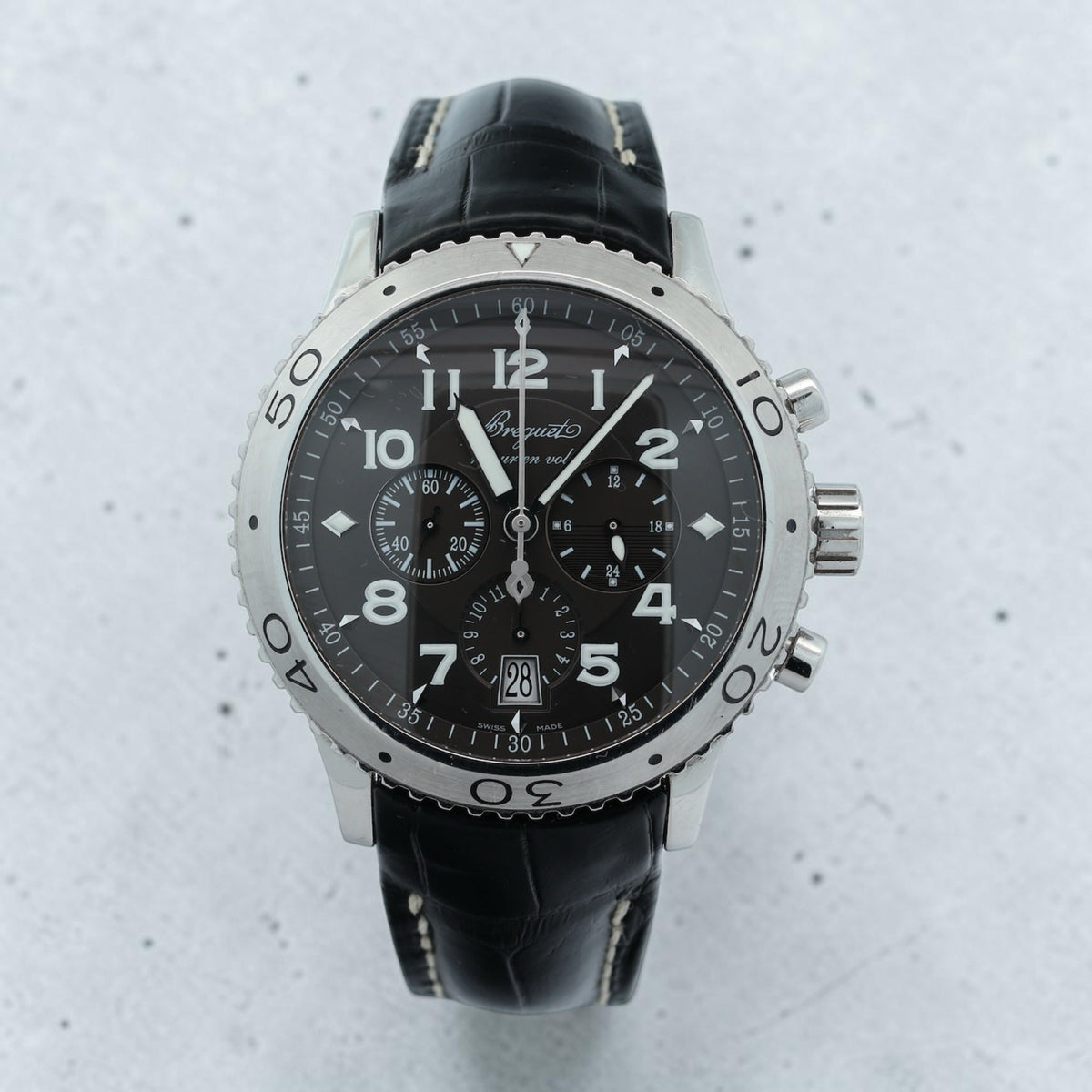
Type XX family watches use subsidiary counters to organise elapsed time, while a central hand records chronograph seconds. The exact number, size and purpose of those counters can change between references. A rotating bezel can add another timing reference, but its scale and layout also vary.
Legibility depends on more than the number of indications. Contrast, hand length, luminous material and the visual separation between the main time and chronograph displays all matter. Before buying, practise locating the start/stop and reset pushers, reading the relevant counter and returning the chronograph to zero.
The existing article Breguet Dials Explained looks at the house’s classical visual language. The Type XX shows a different side of Breguet: function-led design shaped by aviation and elapsed-time measurement.
Type XX generations are not one fixed specification
Breguet describes the Type XX chronograph as having developed through successive generations and numerous variants. Case size, movement, dial arrangement, bezel, date display and materials can therefore differ substantially. Specifications from a current model should never be applied automatically to an older reference.
This is particularly important when an advert uses Type XX, Type XXI and Type XXII together as a broad family description. Begin with the full reference and the details of the individual watch. Then verify which generation and configuration those details represent.
Current pre-owned Breguet flyback chronographs
Our current catalogue includes two Breguet reference 3810 flyback chronographs. The linked example is listed with a 42mm stainless-steel case, automatic chronograph movement, Breguet service case and a new Breguet strap and buckle. It is also described as serviced. Check the product page for its stated condition and current availability.
A contrasting option is the Breguet reference 3820 with carbon-fibre dial. Its listing records a titanium case, automatic chronograph movement and Breguet travel case. These details belong to this particular watch and should not be transferred to other examples with similar styling.
Browse the wider pre-owned Breguet collection to compare the aviation-inspired family with the house’s more traditional dress watches.
What should you inspect before buying?
Start by operating the chronograph with guidance. Check that it starts, stops, resets and performs its flyback action correctly. Confirm that the central hand returns neatly to zero and ask about the stated service history. An invoice or service case can provide useful context, but clarify what work was completed and when.
Next, assess the case, bezel, crown and pushers. Look for clear edges, consistent finishing and wear around frequently handled parts. Review the dial, hands and luminous material together, and ask about any known replacements or refinishing.
Finally, check the strap, buckle or bracelet for condition and fit, and identify every accompanying item. Our pre-owned watch buying guide covers these condition, provenance and accessory checks in more detail.
View a Breguet chronograph in Birmingham
To compare suitable watches in person, arrange a private Birmingham viewing at Executive Watch Collection in the Jewellery Quarter. Appointments are available Monday–Saturday, 10am–4pm. Please confirm that the watch remains available before travelling.
Further reading: Breguet’s official Type XX archive history, its account of the military Type 20 and civilian Type XX, and its explanation of the flyback function.